Zentangle is in large part a mindful method of stress reduction. When one tangles, a meditative calm sets in, often releasing unexpected bubbles of creativity that positively excite us into a focused frame of mind as we concentrate on what the pen is drawing. Sometimes we plan our tangling; sometimes the pen seems to take over and the only things left to our minds is to focus on steady strokes, straight lines, and smooth curves. As we are doing all this, the brain and body release endorphins, and we feel better and better.
Endorphins are those feel-good hormones produced by our bodies’ brains and nervous systems to inhibit pain and produce a euphoric state (probably to reduce pain!). They have a calming effect on our nerves. They want to soothe whether the pain is physical or emotional. They also make us want to reach the same levels of feel-goodedness again and again and again. In short, they are addictive.
When we are stressed or under psychological pressure, we tend to tighten up, which causes muscles to ache and heads to throb. Whether we think about it not, we need for our systems to release a few endorphins to make the pain and stress go away. If we don’t take proactive measures to reduce the effects of stress, everything gets worse–muscles knot up more, the throbbing in our heads takes on the sensation of being pounded by a psychopathic drummer, aches increase, and so on in a downward cycle.
Because we often can’t think straight when we reach the point of physical discomfort, the best proactive approach is to practice endorphin-releasing activities to either lessen the effects of stress or to keep stressful situations from taking us to a point of no return. Some people run every day or two; other people work out at the gym; still others take yoga classes. Some of us Zentangle.
Zentangle can be practiced anywhere–in the grocery checkout line, in the doctor’s waiting room, in a restaurant waiting for an order, in front of the TV, in bed–well, anywhere at all. Even if people use smart phones to record appointments and lists, a pencil, pen, and small note pad or artist tile are easy to always slip into a pocket or purse, or keep on the nightstand. Zentangle requires no special clothes or equipment. A smal amount of time–maybe 15 minutes–is all that’s needed, and no appointments or schedules are required.
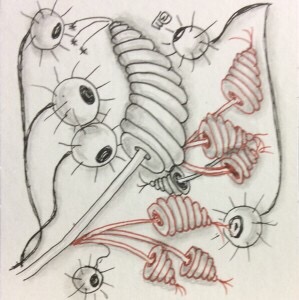
If the paper or tile gets a little smudged or wrinkled as it travels along with you during the day, those elements just add charm and character to the tangle. Here’s a tile I drew while waiting in the car for my husband’s haircut to be finished. Creases from cell phone pushed on top in my purse were accented with graphite. A scribble from a lost pen cap was incorporated into the design–sort of.
Nothing fancy, and I admit I shaded it at home because he came out faster than I expected–but still not a bad little piece of on-the-go tangling. It was a little cramped behind the wheel, as I am very short, but I had enough elbow room to draw and relax a bit ( and I could have moved the seat back). My husband always calls for pick-up too early. Rather than be angry, I tangle while I wait and let the endorphins flow. And if I am not finished when I reach the cashier or my breakfast order arrives (or my husband gets in the car) I can set the tile aside to complete it another time. I don’t need to worry about forgetting what the next step was supposed to be because Zentangles are unplanned. The patterns should be those that come to me when the pen reaches a blank space. When that space is reached–in the next microsecond, a year, or any time in between–the pattern that comes to mind is the one that goes there. It’s OK to plan the patterns; it’s just not necessary.
An idea just came to mind. It is time, I think, to tangle another tile and get another endorphin fix.
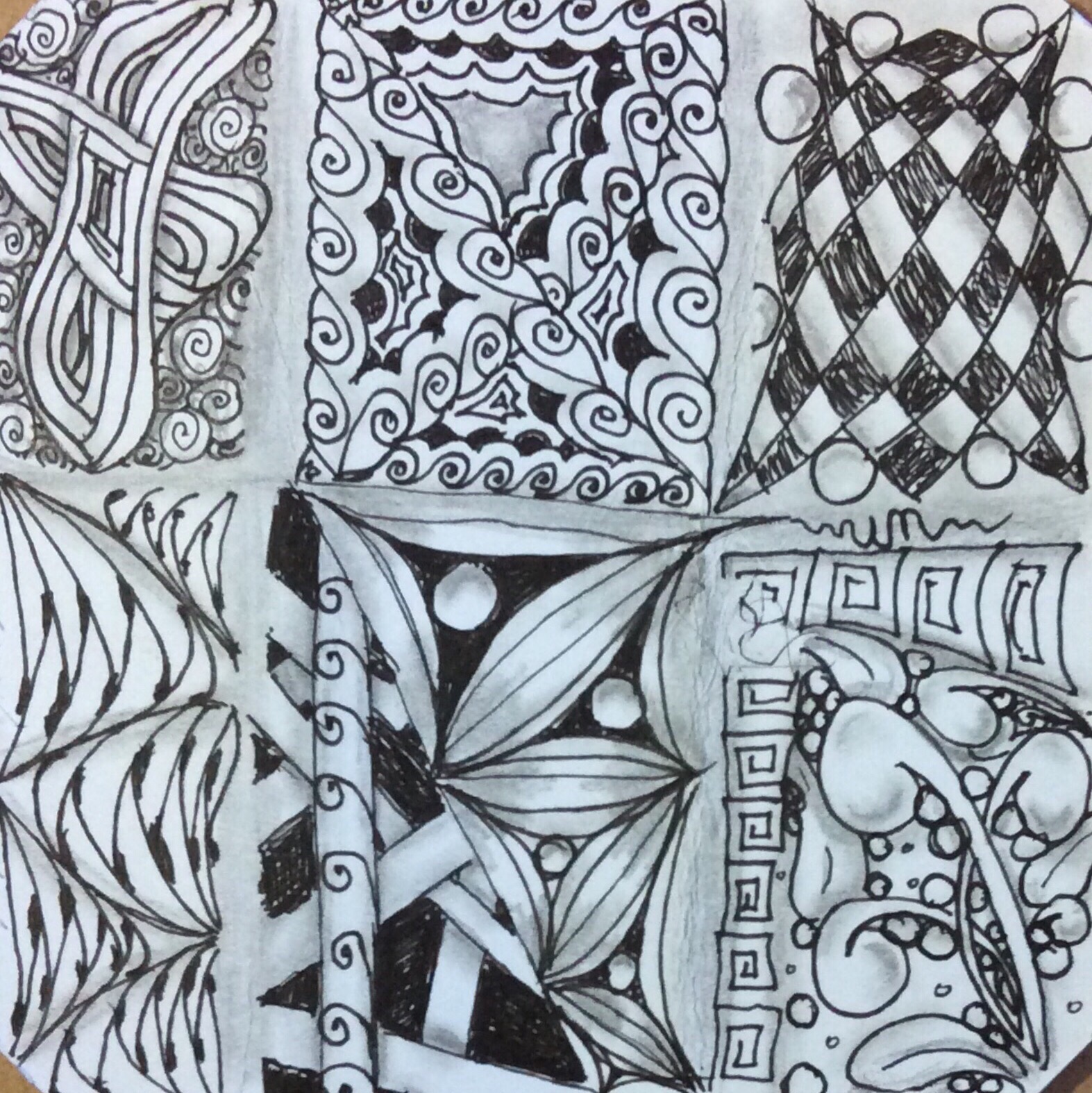
Browsing through my album of tiles and my sketchbooks over the weekend was an interesting and surprising experience. I have been tangling since the end of April, 2016–about 10 months. What I saw was growth as well as regression–typical of any learning progress. When my work became more attractive, the same patterns and techniques appeared in a cluster. During times of learning new techniques and patterns, the work became cluttered or less cleanly drawn. The pattern kept repeating in cycles, only now becoming less extreme in its swings.
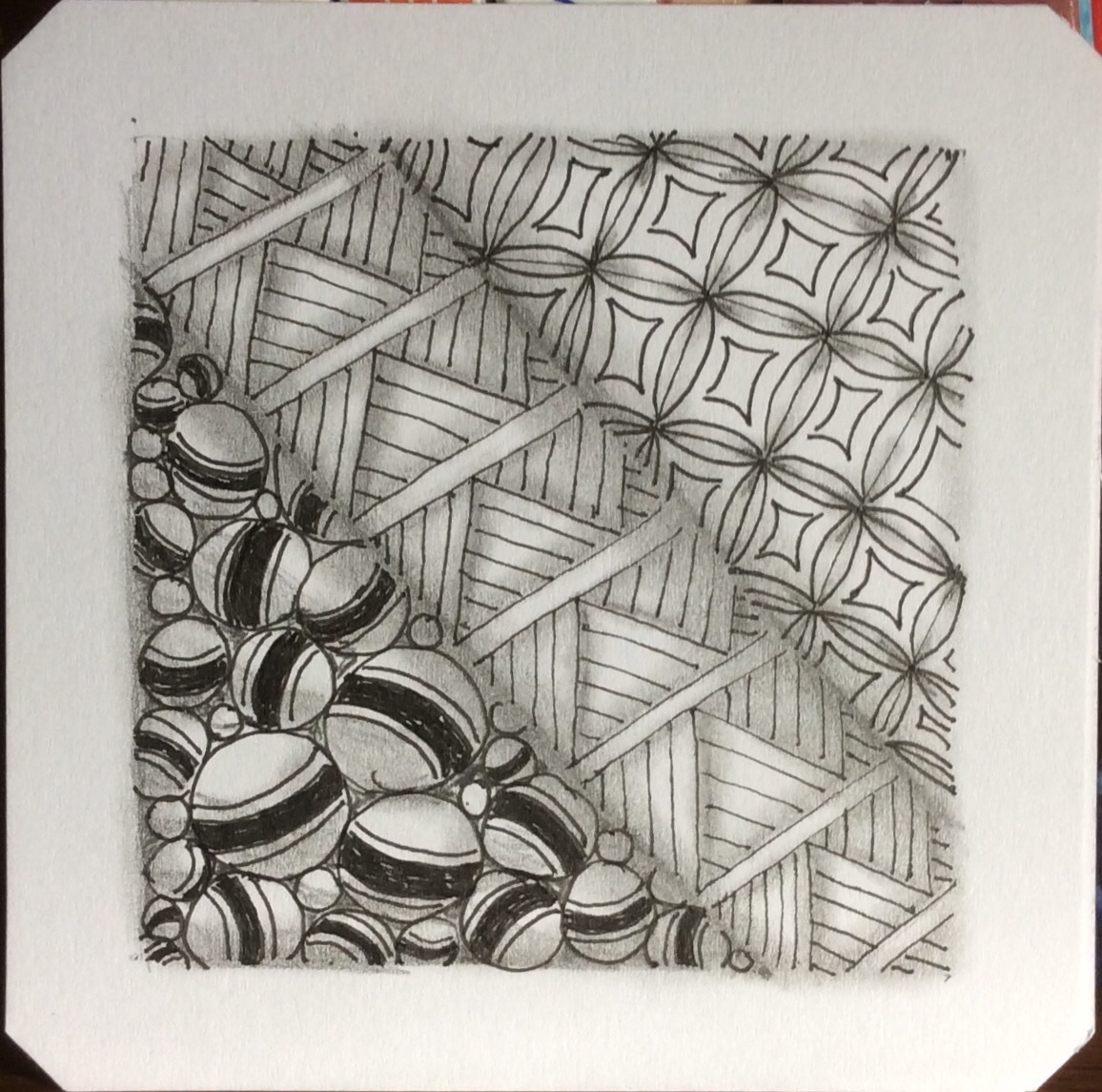
One of my first tangles, late April, 2016. I thought this was so cool! I knew only 9 patterns then, and I included them all!Today’s morning meditation is cheerier, more confident, with a pattern or two learned in the past week. I can confidently draw over 100 patterns now, am familiar with a couple hundred more, and I keep learning a new one or two each day. Only 7 patterns were used.
If you look at the tangles above, you can see that, in my early tile, what I lacked in pattern skills I tried to hide behind a bit of flare. Today’s tile is less stilted. Whether it is more pleasant to view is not my call, but I find it more breezy, better developed, and stronger, even though two of the patterns used here are out of my sketchbook and on a tile for the first time.
To be honest, I have no inate artistic talent or abilities, and it is only about three years since I learned to produce any art at all. I took up drawing lessons to learn to see things as an artist might, and had limited success. My teacher suggested switching to acrylics (I’m too slow) or oils (which I feared). I even picked up watercolor books and videos and tried to learn that, only to discover that watercolor presents its own unique set of challenges. Then, less than a year ago, I learned about Zentangle.
I had been looking for a method of meditation and relaxation that involved movement. Although Tai Chi was an option, I couldn’t find classes here on the island–not then, anyway. Besides, going to a Tai Chi class would have involved getting into the car and searching for parking–not very conducive to relaxation.
“Zentangle” was a term I remembered referenced in several of my art how-to books. I thought at first it was some new professional school or method of art. Then I found out it isn’t art in the traditional sense at all–it’s Zentangle, pure and simple. That it centers around drawing is a good thing, I thought to myself. That it can be done by even the most artistically challenged is even better! So I researched more.
Although certified Zentangle teachers (CZTs) can be found all over the world–increasingly in China and India–none seem to be in Sint Maarten, the tiny island (well, half-island) country in the Caribbean. So I ordered a book or two from Amazon and set out to see if I could teach myself. I spent well over 20 years teaching children and young men and women professionally. Surely I could teach myself, too.
And I did teach myself Zentangle, of a sort. On the official Zentangle site, Zentangle.com, the recommendation is to learn the Zentangle method from a CTZ through a workshop. The second best way to learn is by purchasing the Zentangle Primer, Volume 1, and the Zentangle starter kit, both available for purchase on the web official site. After months of trying with other sources, I broke down and purchased both. Not only did I wish I had done that from the beginning, but I also decided that, because Zentangle was so helpful to me, I wanted to bring Zentangle to this tiny island. In two months, I will be attending a Zentangle seminar to become a CZT so I can do just that. My copy of The Zentangle Primer gets used almost every day. I may never get to all the ideas inside! The book contains step-outs for dozens of patterns that make the complex easy to draw and embellish, as well as dozens of sample “fragments” to develop and “reticula” ideas for grid tangles and strings.
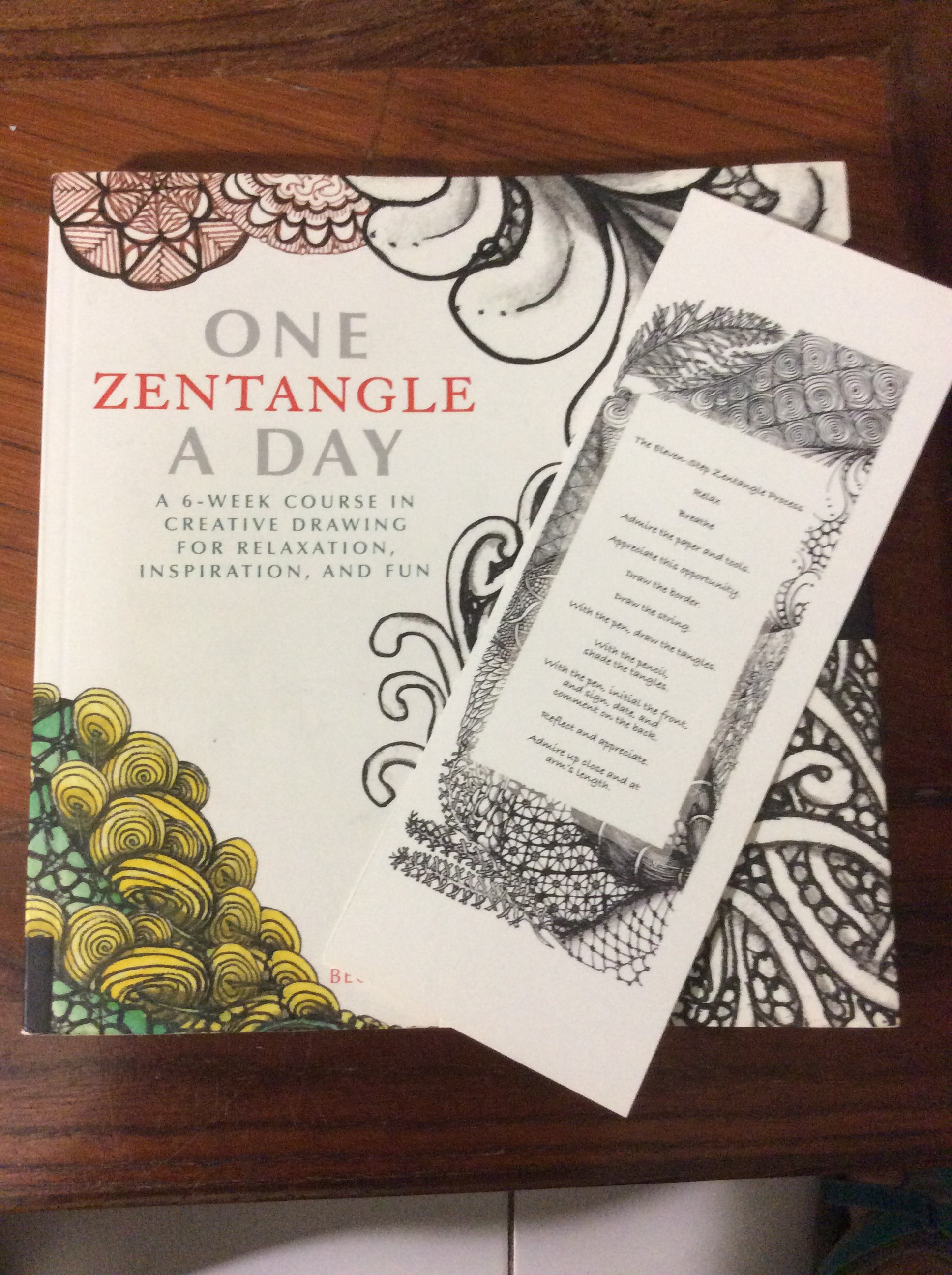
Here’s the thing: I may not have started off with the best self-teaching materials, but I did start off with an excellent resource, One Zentangle a Day, a book by Beckah Krahula, CZT.My well-used copy that contains six weeks of lessons and about 75 patterns with step by step directions.It gave me enough information and techniques to get me started, even if I became frustrated sometimes. As a beginner’s reference, it is a great book, especially if you are looking for at least a little of the mindfulness and relaxation benefits. It contains a lot of information for trying Zentangle on for size, but it doesn’t cover Zentangle principles in depth. A great “first” book at low cost. If all you are looking for is art or crafting ideas, it is also a great source of ideas and buying information. But for a deeper understanding of the Zentangle method and its effects on calming your mind and increasing both focus and creativity–and if you want a book that will continue to be a resource for years to come–then The Zentangle Primer is a must-have book.
For me, a helpful resource is an app called Zentangle Mosaic, available in Apple iPad and iPhone format, as well as in Android format. It is an excellent source of inspiration, tips, and friendly and supportive members from all over the world. Many well-known and respected CZTs share their work on the app regularly. Many up-and-coming CZTs participate and provide advice and support. Zentangle founders Rick Roberts and Maria Thomas share their own work, new ideas, and even exclusive videos there. Rick, Maria, and their family interact with members all the time, providing feedback and encouragement, especially to new tanglers. It is a marvelous community of tanglers. Posted work is validated for its “Zentagleness” (my word). There is a free option, if all you want from the app is inspiration, and a paid option, which allows you to upload photos of your work and actively communicate with Mosaic subscribers. I don’t know enough about the free version to compare it to the paid subscription, but I believe that, as lovely as the free version is for viewing others’ work, the most useful features come only with membership. To me, the benefits I derived from the paid subscription is priceless, especially since I tangle alone here on the island.
Encouragement from members of Mosaic got me participating in national and international challenges on Facebook and blog sites. The challenges are not as supportive as Mosaic, but I have learned to judge tangles on “Zentangleness” instead of eye candy. Many challenge submissions are Zentangle Inspired Art, which can be beautiful and whimsical, but a lot are by professional artists. They each have something to teach, though, even if the intention is not there. There are many artsy and craft ideas presented by challenge participants. Mindful tangling is difficult to put out there when one is not an artist. My tangling may not compete in artistry, but it solidly represents the Zentangle method and purpose. After one or two posts, I was no longer intimidated by the pros. For an example of a short (two-week) challenge, visit “valentangle2017” on Facebook. It came with a book of instructions for what to include in each day’s tile, along with lovely examples to use as models. The contributor pool was just over 200 participants–small by Facebook standards. Lots of beautiful work on display, though.
All of these resources have helped me grow as a tangler. I firmly believe, however, that workshops are the best way to learn Zentangle. When I tangle alone, even with supportive online communities available, it’s difficult to get questions answered or discussions on techniques moving smoothly. There is something about face-to-face contact that helps those of us seeking the mindfulness and meditative aspects of Zentangle. Hopefully, I won’t be tangling “alone” on the island for much longer!
About ten months ago, I came across Zentangle as I was researching forms of meditation, especially those I could somehow learn on my own. I had recently lost my mother, and I felt life imploding on me even though we had not been as close as we once were. Being still is more than difficult for me–it is impossible. I have more than a touch of Attention Deficeit Disorder (ADD) and need to move or be doing something if I want to concentrate. So most meditative methods seem to be out for me. I had thought about Tai Chi, but I live on a tiny island, where offerings are few. Then I came across Zentangle, and got interested in the idea of meditating through repetitive drawing of patterns.
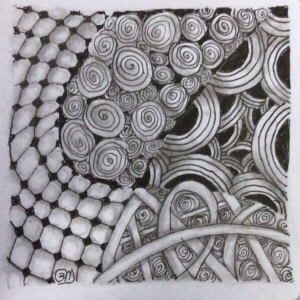
A Primer Lesson 1 tangle from my files.
No one will ever accuse me of having even the slightest artistic talents. I took drawing lessons a few years back to learn perspective and techniques; the lessons helped, but talent was clearly lacking. So Zentangle’s claim that artistic abilities were not necessary intrigued me. I had to learn more.
According to the official web site, Zentangle.com, the best way to learn the Zentangle method is to attend classes offered by a Certified Zentangle Teacher (CZT) in my area. Well, the island of St. Martin in the Caribbean Sea is small, and Zentangle hasn’t made it this far. I live in Sint Maarten, the Dutch country on this tiny island. The French side has a slightly smaller population. Even between the two countries, the total population is barely that of a small town back in the States. It is not surprising that there are no CZTs here, even though there are plenty of them in the Netherlands. Clearly, I would be on my own.
The second best method of learning to tangle, according to the web, is to purchase the official book. Instead, I bought a copy of a book called One Zentangle a Day, basing my purchase decision on the far lower cost compared with that of the official Zentangle Primer. I ordered One Zentangle from Amazon, along with the recommended pen, 3.5-inch square artist tiles, tortillions, and 2B pencils. Once I had everything together, i started experiencing Zentangle.
Each day, I poured my morning coffee and got out my book. Often, it took me longer than a day to complete a lesson, as I found myself getting frustrated with my apparent inability to draw even the simplest shapes and patterns. Clearly, I was doing something wrong, as I was not getting the expected benefits. As I “meditatively” journaled my journey into tangling on my writing blog (Write of Passage)–or maybe I was critiquing?–I began to notice a change in my attitude toward the process. It was actually working!
As I tangled my way through the book, I kept reading up on Zentangle. Finally, I broke down and purchased the official Zentangle Primer: volume 1 from the web site. Before making this purchase, I bought several e-books on tangling, and even a set of workbook-like books. By then, I had spent close to 4 times the cost of the Primer.
A tile from Primer Lesson 2As it turned out, The Primer is all I really needed! The Zentangle method and philosophy is clearly laid out, including the celebratory nature of The Zentangle method and process. The reasoning behind the steps of the method is clearly defined, beginning patterns are illustrated as “step-outs” (which provide breakdowns of drawing even some very complex patterns!), and easy to follow lessons provide a framework for drawing. Even methods of shading and highlighting are included to add depth and dimension to basically flat drawings. Patterns, as presented, progress logically so that elements and methods from an earlier pattern are clearly evident in patterns of greater complexity. Best of all, entire charts of “fragments” to be used in rectangular, triangular, and circular grid spaces provide ideas and jumping off points for working on one’s own–including development of one’s own patterns and fragments. Everything a beginner needs to get started correctly is in the Primer, and web sites for inspiration and more advanced patterns are listed for the adventurists.
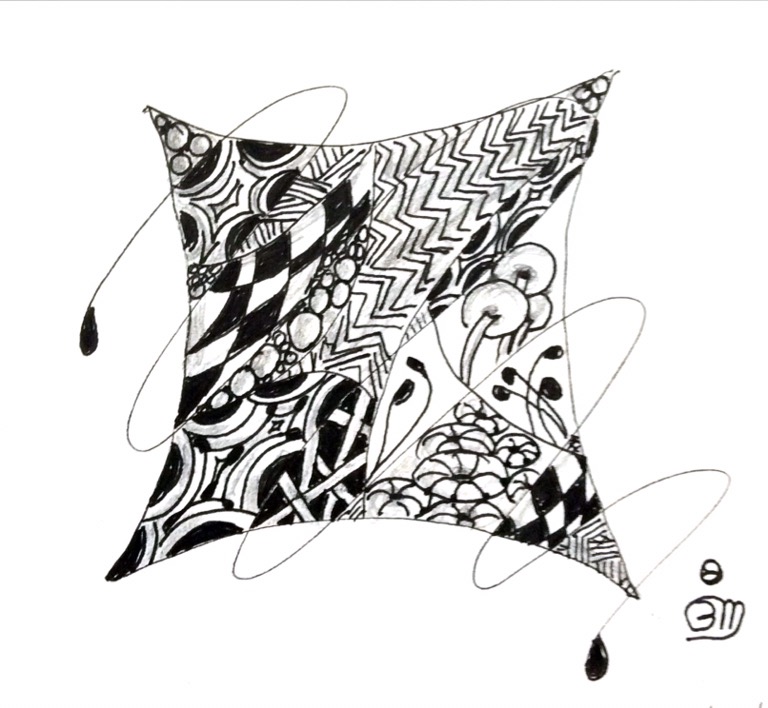
My work is not fancy, although I have learned to experiment with different materials and media for an occasional artistic touch. Tangles who understand the Zentangle method and process see the work for what it is and are not influenced by fancy patterns and flashy colors. That’s not to say fancy tiles have no place; it’s just that the simple process, simple tools, and simple black ink reduce the process to its essential elements–simple, controlled, relaxing, meditative strokes. The Zentangle motto is “Anything is possible one stroke at a time.” The products of advanced tanglers attests to the creative processes released by this clean and simple methodology. A “3Z” tile recently completed for the Valentangle2017 challenge on FB
At this point, I have been tangling for ten months, and using the Primer for about half that time. When I need to touch base with my center or need to relax, I reach for a tile, my Micron pen, my 2B pencil, and a torillon. I go through the eight steps discussed in two previous posts. And I begin to lose myself in the process of Zentangle. I don’t have to be home to tangle, and the small size and simple tools are so portable that a “kit” can be carried easily in a pocket or bag so I can tangle anywhere. As I tangle, thoughts pass through my mind. As in any meditation, some are let go, others are contemplated while part of my mind focuses on drawing a pattern or two. Sometimes, I need to tangle more than one tile to get full benefit. Sometimes I lose concentration and need to set a tile aside. Sometimes, an “artsy” inspiration comes to me for later or immediate attention. Each time I create something new. Each time, I learn something new about the process, pattern manipulation, or myself. When I make a mistake, I incorporate it into the process and move on. In Zentangle, there are no mistakes, only opportunities–for growth, for change, for coping, for living, for learning.
Simple tools, simple process, celebratory appreciation, meditation–all while producing a miniature work of art.
In a Part 3 of this series, I discussed the first four of eight steps in the Zentangle® method. These are 1) Gratitude and Appreciation, 2) Corner Dots, 3) Border, and 4) String. Today’s post will talk about the other four: 5) Tangle (or Draw), 6) Shade, 7) Initial and Sign, and 8) Appreciate. I will also talk about some of the intangible aspects of Zentangle that make it different from doodling and traditional arts.
Just a word… this is a lengthy post because it covers a lot of information–about what goes into each step and materials. Bits and pieces will be covered in future posts in more detail, and one at a time. In general, this is an overview of the next four steps of the Zentangle Method, and of the very few materials you need to get started. On to the discussion…
Steps 2 through 4 are done in pencil for reasons that will become clearer in a minute. For Step 5: Tangle (or Draw, depending on the age of the source; Tangle is the more recent step name), a pen is used. Using the pen, the tangler fills in the spaces created with the border and the string in Steps 3 and 4. The patterns used are generally those that are recognized by the Zentangle community as being either official Zentangle patterns or those created and shared by tanglers around the world. These can even include your own pattern designs! Step-outs, or step-by-step illustrations on how to draw the patterns, can usually be found on the internet. The largest repository of Zentangle step-outs is TanglePatterns.com. Although some of the patterns (or tangles, if you prefer) look extremely complex, they are easy to create by following the steps in a step-out. When first starting out, it is generally best to stick with a handful of tangles until comfortable with the Zentangle method.
Step 6 is when shading is added. Shading within and among patterns gives the tangled tile dimension and texture, not to mention movement. The difference between an unshaded tile and a shaded one is like the difference between a simple flat road map and the satellite view in Google Maps. There are recommended ways to shade particular patterns, but experimentation is the best learning tool.
In Step 7, Initial and sign, the tangler adds a “chop” of their initials on the front of the tile. (I will talk a bit about the chop in a later post.) On the back of the tile, the artist signs his or her full name. This step locks in one’s ownership of the finished piece. You created this little masterpiece, and, just like any artist, you sign it to let the world know you created it.
Finally, the pen is set aside and the artist studies the composition, rotating the tile to view the work from all angles. This is Step 8 in which you Appreciate what you have created, and decide how you want it displayed. You have put time and effort into your work, and you have set your mind free to wander or contemplate as you drew. Now that you have finished, you can study how the part of your mind that was concentrating on the drawing helped you create something unique and personal. Appreciate what your meditation has helped you create.
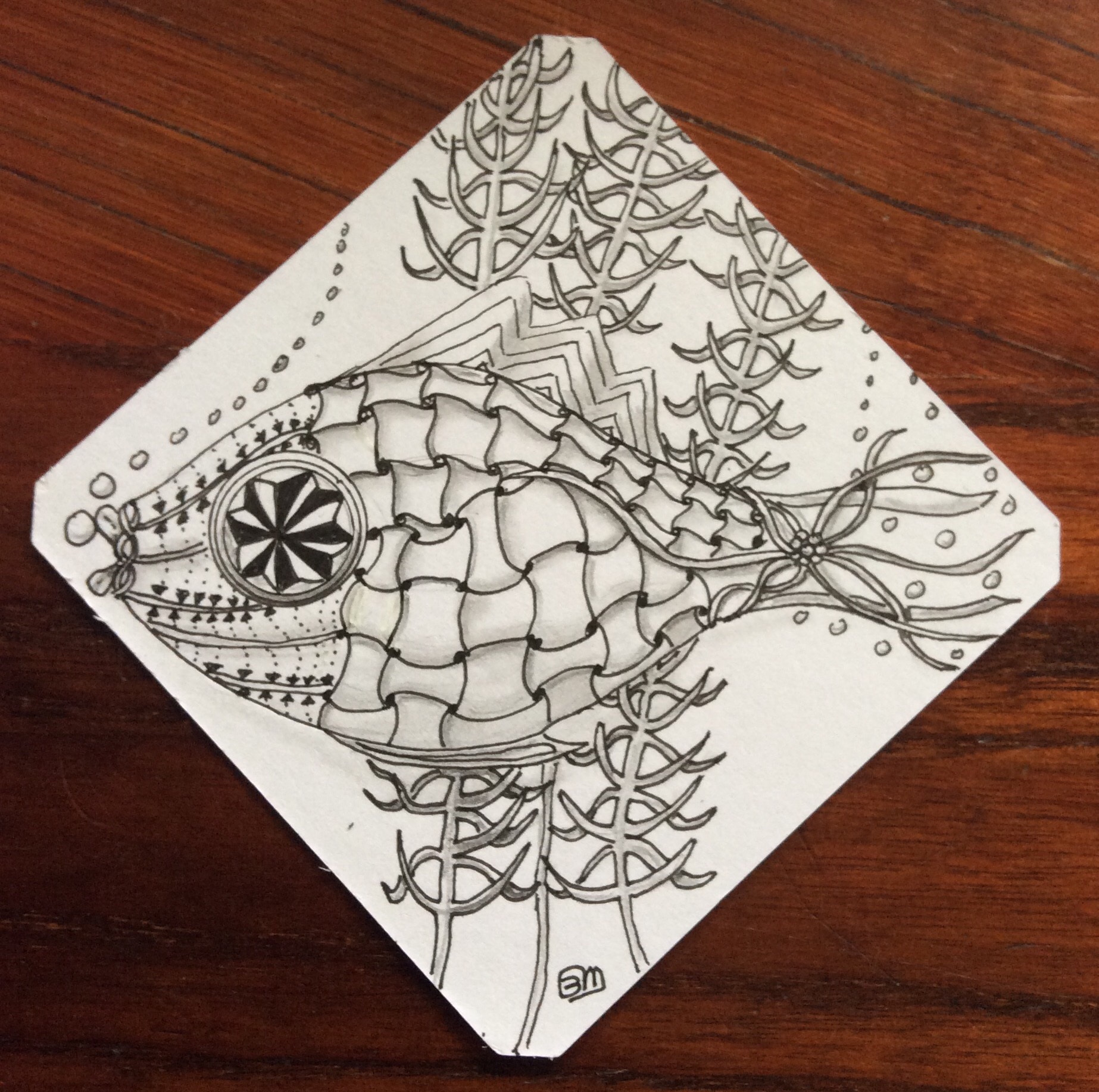
That is all there is to creating a Zentangle tile. The composition of the tile is “non-representational;” that is, it is not meant to be of something. In fact, if you are tangling with a picture in mind, chances are you are creating a ZIA–Zentangle Inspired Art. Many professional artists are now adding Zentangle patterns to their work to add fresh interest or texture. For example, one of my earliest attempts at a ZIA is a simple fish that one would never find in nature. Because I had intended to draw a fish, and because it has an obvious direction from which it should be viewed, it represents something, even if it was something from my imagination. Although the entire picture is done using Zentangle patterns, it is not a Zentangle. It is a ZIA.
Every stroke on this tile makes up a Zentangle pattern, but this is NOT a Zentangle!A Zentangle may look like something real at the end, but the work itself is done without any particular object or subject in mind. Rather, a Zentangle is the result of your mind wandering around, but making suggestions of what patterns to use to fill the spaces created by your border and string(s). If I hadn’t intended to create a fish, then the tile would have been a Zentangle. But what are the chances that an obvious fish would come out of just drawing patterns? It is possible that a fish-like shape would emerge from the process, but unlikely that a clearly outlined fish would emerge.
So another aspect of a finished Zentangle is that it can be viewed and appreciated from any angle. That is, what started out as “top” with your first strokes may end up being a side in its most complementary position. Tanglers rarely draw from one tile position. Instead, they “spin” the tile for ease of drawing certain patterns, or to more easily fill in an empty space. Some tanglers find it easiest to draw certain strokes from left to right, for example. If the composition wants the pattern to go in a new direction, the artist turns the tile so that it is in the best position for the line or curve to be drawn in the favored direction. Experienced tanglers are constantly spinning their tiles as they work. Besides, because the patterns themselves are non-representational and non-directional, it matters little how the tile is aligned as the patterns are being drawn–except as needed to complete a pattern, of course.
A word about materials…
Although tangling–the process of drawing the Zentangle patterns–is generally done with a Micron® 01 black pen, any fine-tipped porous marker can be used. The finer the line, the better, especially for adults. The Micron 01 is recommended for a lot of reasons: it dries immediatelymso it does not smear or bleed, it is archival quality and will not fade ever, it draws one of the thinnest lines at an affordable price, and it is waterproof. The final quality becomes more important as the tangler begins to experiment with the addition of media such as watercolor or colored markers. The Micron 01 will not bleed into color or other treatments. A lot of pens that I have tried claim to be waterproof, but adding watercolor or artist marker over a drawn line can cause the black to bleed into the color, pretty much messing up whatever effect the i was going for.
Because the line of a Micron 01 is so fine (.25 mm line width) the ink dries instantly. Wider fine line markers–even the Micron brand–take a bit longer to dry and might smear accidentally when the hand brushes it or shading is added too soon. The Micron 01 also produces an instantly waterproof line. Several other artist quality brands take from an hour to a day to resist bleed when other media are applied. During experimentation, I have had inks bleed blue or brown into watercolor or artist ink. Having a tile ruined because of bleeding is frustrating, even if the addition of something else can “save” the work. It is hard enough to incorporate an unexpected line from the jerk of a hand or loss of concentration. To have a piece that is completed except for the addition of a bit of watercolor can ruin a meditation, even though the work can be saved–it is no longer what one expected.
For shading, a 2B drawing pencil is recommended. The 2B hardness is dark enough to add dimension to tangles, but light enough so that it can be blended smoothly. Using too dark (too soft) a graphite lead can leave the shading looking sooty when shadey is the desired effect. Also, the softer the graphite, the more likely it is to smear accidentally.
Not all 2B pencils are the same, however. It is a good idea to purchase several brands of 2B drawing pencil to figure out which works best for you. Some brands (or classes within the same brand) are darker or lighter. There are no industry standards about how dark or soft a 2B is. It seems that every brand determines its own 2B degree of softness, probably based on the hardness or softness of the other graphite pencils in its line.
It is also a good idea to have a 2H pencil for drawing corner dots, borders, and strings. More than likely, you want these to “disappear” into your finished work rather than have the line stand out. Erasers are frowned upon in Zentangle, as the idea is that, in life, you can’t always undo a mistake. So the motto, “There are no mistakes,” becomes a metaphor for life. As such, tanglers do not erase. Instead, they incorporate the flaw into the piece by changing the outcome of a pattern, even if it seems to be a cover-up. The point is to move on by using the mistake to create something new or different, and going on from there. Back to the 2H pencil, though. The pattern drawn in black ink hides the lighter graphite line of a 2H, or the 2H border or part of the string is easily blended into the shading of the piece.
For blending graphite into shading, a tortillion or blending stump is generally used. You can use your finger, but the graphite on it might transfer onto the tile exactly where you do not want it. It is easier to keep clear areas clean with a blending tool.
The only other thing needed for Zentangle is something to draw on. The recommended surface is a square paper artist tile that measures 3.5″ by 3.5″. The official tiles, which can be purchased from Zentangle.com or from a CZT (Certified Zentangle Teacher), are recommended for a number of reasons. The paper is high quality that professional artists use. It is also strong and thick enough to use with watercolor and markers without buckling or allowing bleed-through of inks or watercolor. The smoothness (“tooth”) of the paper is perfect for ink and graphite art, and is wonderful for watercolor.
Although the official tiles are a bit more expensive than other available tiles on the market, it is best to use the best quality materials you can afford. This is true for any art, not just Zentangle. Lower quality materials can effect the outcome of work at any level of expertise. It is generally more difficult to work with lower quality materials, and this can negatively affect the enjoyment of the art form. Plus, you are worth a few cents more per tile. Or for a pen or pencil…
Bottom line: anything can be used for tangling. Some tanglers draw everything into a sketchbook or unlined journal. From experience, I can tell you that it is easier to compose a tangle on a tile because there is nothing to interfere with the drawing process–no coils, no change in surface height, no difficulty in spinning the work. Otherwise, any notebook or piece of paper can be used for tangling–even glass or fabric or other surfaces. The internet has many examples of everyday items that have been tangled, whether to hide marks or to simply beautify a too-plain object or area. All you need is the special tools for working on the particular surface: china paint, fabric markers, wood-burning tools–whatever the surface calls for. Zentangles can even become the focal point of jewelry or holiday ornament. Lots of ideas can be found on the internet and in books, as well as at CTZ-led workshops and classes in your area.
Zentangle is world-wide. There are few places on Earth near which a CZT can’t be found. Although there is much information available on the internet or in books, the best way to learn how to tangle, expand your tangling horizons, and experiment with new techniques and materials is with a CZT (Certified Zentangle Teacher). If you are on the island of St. Martin in the Caribbean, you can tangle with me. Just contact me at ellie@tanglesxm.com. Everywhere else, check out Zentangle.com for a listing of CZTs in your country or near your home. I won’t be a CZT until May of 2017, but we can always have some tangling fun together before that time.
Until next time, when I tell you why I tangle, Happy Tangling!



 TangleSXM